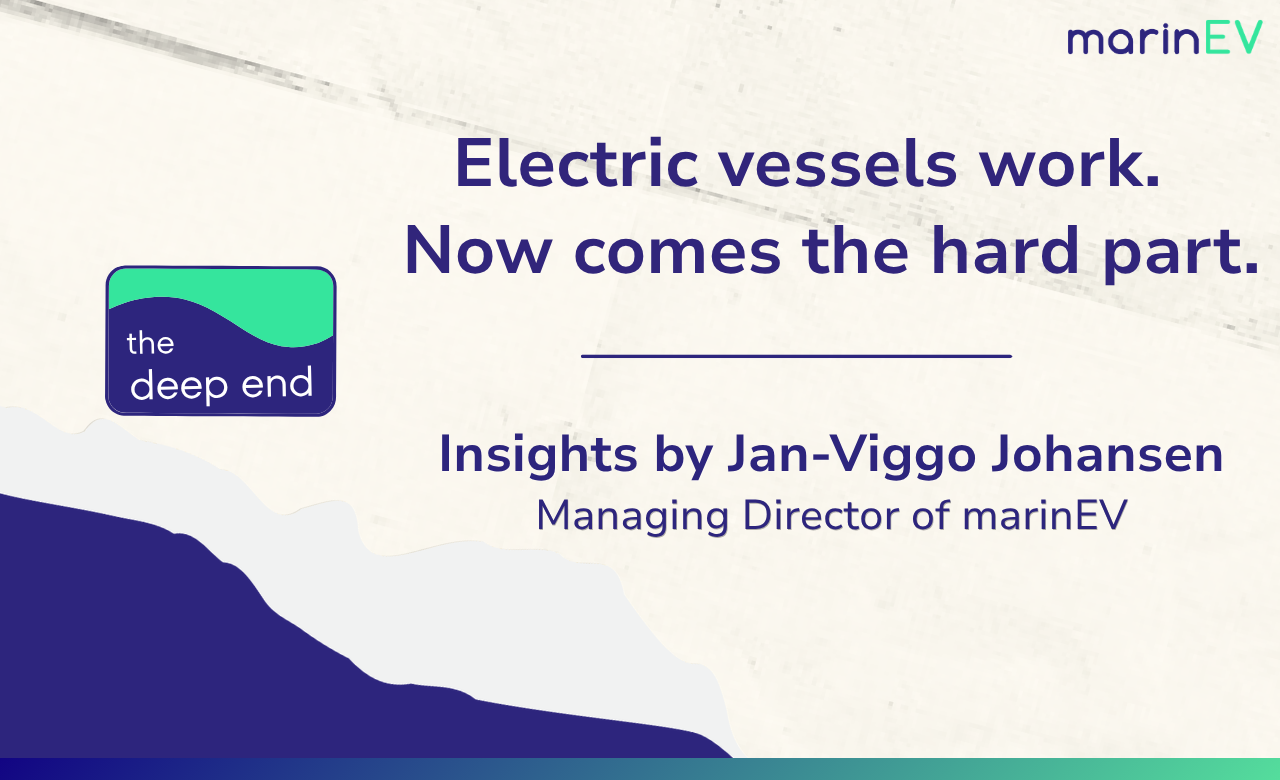
Every major innovation reaches a point where proving that it works is no longer enough.

Mass adoption of new transport and energy technologies has historically depended not only on the technology itself, but also on the infrastructure, operating models, regulation and markets needed to support it.

Maritime electrification is reaching a similar point.

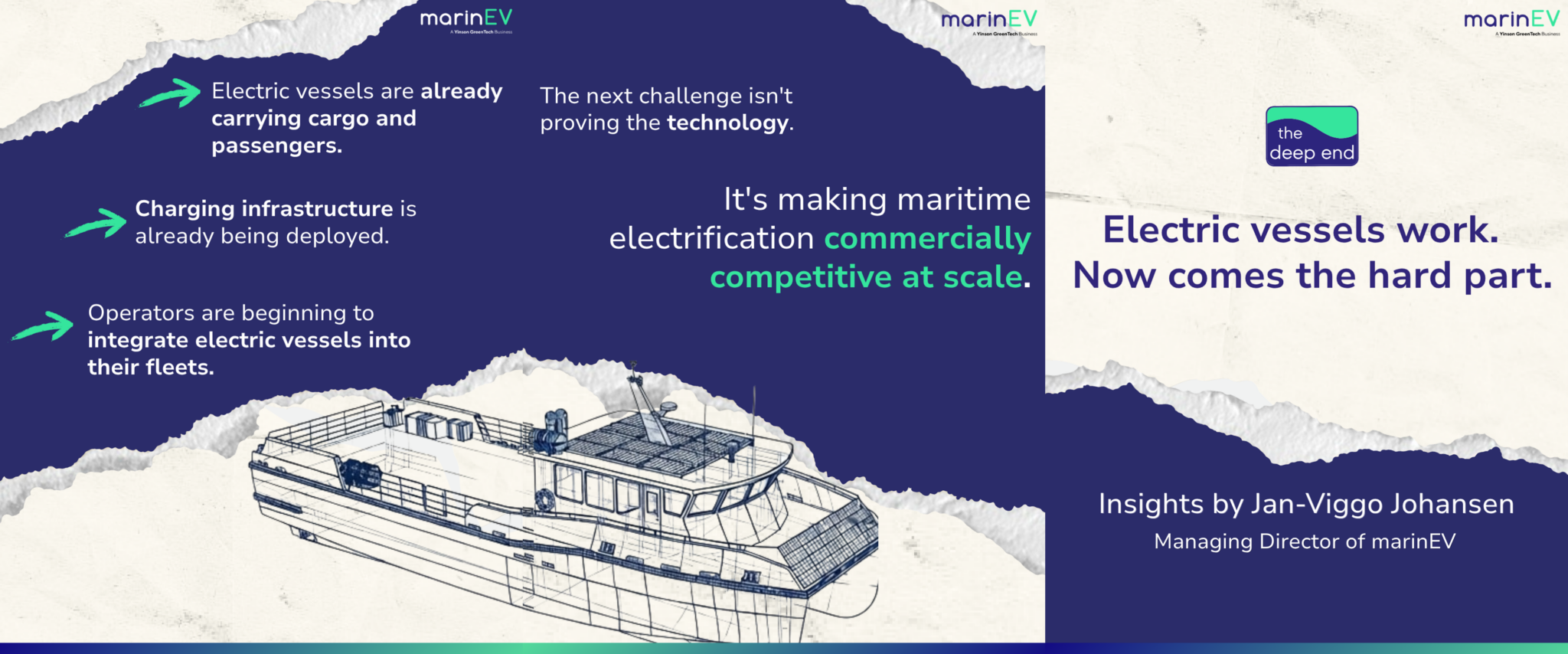
Over the past few years, maritime electrification has moved rapidly from concept to real-world operations. Electric vessels are carrying passengers and cargo, charging infrastructure is being integrated into working ports and logistics bases, and commercial operators are beginning to incorporate electric vessels into their fleets.

In Singapore, this transition is particularly visible. From 2030, all new harbour craft operating in Singapore port waters must be fully electric, capable of using B100 biofuel, or compatible with net-zero fuels. Singapore has also introduced a dedicated technical standard for electric-harbour-craft charging and battery swapping, while charging infrastructure and pilots are increasingly being developed around real operating requirements.

At Toll Offshore Petroleum Services (TOPS), Singapore’s first decarbonisation hub dedicated to electric supply vessels brings together electric marine transport, purpose-built charging infrastructure, warehousing and cargo logistics in a working operating environment. Together with other charging-infrastructure initiatives across the port, these developments are beginning to create the ecosystem needed for electric harbour craft to operate as part of normal maritime business.

At the same time, electric harbour craft are moving beyond trials into contracted commercial operations.

The question is therefore no longer whether electric vessels can work.

The question is how we make them commercially competitive at scale.

Scale requires competitive economics

Operators do not adopt technology simply because it produces fewer emissions.

They need vessels that can be written into contracts, scheduled into existing operations, supported by reliable infrastructure and operated without introducing unacceptable risk to margins, uptime or service delivery.

That means every deployment ultimately has to answer some very practical questions:

  • Can the vessel perform the required duty cycle?
  • Can it charge within the available operating window?
  • Can crews and customers adopt it without unnecessary complexity?
  • Can it deliver acceptable economics?
  • And, critically, can the model be repeated at scale?

Industry therefore has strong incentives to continue reducing cost through greater standardisation, simpler designs, optimised battery capacity, more efficient construction, stronger supply chains and more competitive financing.

Nor should the industry assume that public support can compensate indefinitely for solutions that are not commercially competitive.

But there is another side to the equation.

Scale changes the economics

Conventional vessels benefit from mature supply chains and decades of accumulated operating experience.

Their engines, components, shipyards, fuel infrastructure, financing practices and maintenance networks have developed around large, established markets.

Electric harbour craft are competing against that mature ecosystem while still establishing their own.

That creates a familiar challenge for emerging technologies:

Cost needs scale, but scale needs demand.

Without sufficient demand, manufacturers have less opportunity to achieve production efficiencies, standardise designs or negotiate supply-chain economics associated with higher volumes. At the same time, higher early-stage costs can make operators more cautious about adoption.

This is not unique to electric vessels. It is a common feature of technologies moving from demonstration and early adoption towards larger-scale industrial deployment.

Creating the conditions for scale

Norway’s maritime transition provides one useful example.

Electric ferries did not reach today’s level of maturity through technology development alone. Public procurement, targeted support mechanisms, infrastructure development and progressively stronger environmental requirements all contributed to creating the conditions for adoption.

Norway has used public procurement to stimulate low- and zero-emission ferry solutions. Environmental and technology requirements have progressively been incorporated into public ferry tenders, including requirements for low- and zero-emission solutions where technologically feasible.

This created repeated opportunities for operators, shipyards, equipment suppliers and technology companies to deploy, learn and improve the technology. Battery-electric propulsion has subsequently become widely deployed across Norwegian ferry operations.

Other markets have followed different routes.

China’s national policy for the green and intelligent development of inland vessels explicitly promotes battery-electric vessels, standardised and serialised vessel designs, stronger industrial and supply chains, charging and battery-swapping systems, and new commercial models including vessel leasing, centralised manufacturing and battery leasing.

Singapore is taking a different approach, combining long-term regulatory direction with technical standards, infrastructure pilots, vessel-development programmes and charging-infrastructure planning.

The mechanisms differ, but the underlying principle is similar:

Emerging technologies often require an early market before the efficiencies associated with mature-market scale can be realised.

In my view, the objective of public policy should therefore not be to make an uncompetitive technology permanently competitive.

It should be to help create the conditions in which promising technologies can be tested, adopted and scaled while industry works towards commercially sustainable economics.

From support to self-sustaining economics

I think about that transition in four stages:

CREATE  ->  PROVE  ->  SCALE  ->  TRANSITION

CREATE the conditions for early adoption through clear regulation, infrastructure, procurement and targeted incentives.

PROVE the technology through real commercial operations, generating the operating data and confidence required by customers and financiers.

SCALE successful solutions through standardisation, repeat orders, supply-chain development and increasingly efficient production.

TRANSITION away from transitional financial support as scale economics improve and commercially competitive solutions become established.

Industry has an important role throughout that journey.

Each generation of vessel should aim to become cheaper to build, easier to operate and easier to finance. Each deployment can also generate operational data and experience that reduce uncertainty for subsequent customers.

At the same time, early markets may require mechanisms that reduce the barriers faced by first movers while production volumes, infrastructure and supply chains develop.

This is why effective decarbonisation strategies often combine industry development, customer adoption, infrastructure and public policy rather than treating them as completely separate challenges.

The next phase: from deployments to scale

Maritime electrification has already moved a long way from where it was only a few years ago.

In Singapore, we are now seeing the pieces of an emerging ecosystem come together: regulatory direction towards 2030, a dedicated technical standard for electric-harbour-craft charging and battery swapping, charging-infrastructure pilots, purpose-built facilities such as the decarbonisation hub at TOPS, and electric vessels entering contracted commercial service.

At marinEV, we are experiencing that transition ourselves.

Hydromover began as a technology-development and demonstration programme. The original Hydromover was launched in 2023 as Singapore’s first fully electric cargo vessel and subsequently underwent operational and commercial trials. Lessons from those deployments contributed to the development of Hydromover 2.0, marinEV’s next-generation electric cargo platform.

Today, Hydromover vessels are entering contracted commercial operations in both Singapore and the UAE.

That progression – from development, to demonstration, to commercial deployment – is exactly what the transition needs.

But deployment is not the finish line.

The next challenge is turning individual deployments into repeatable demand, repeatable demand into production scale, and production scale into increasingly competitive economics.

Industry has an incentive and responsibility to keep reducing cost with each generation and each vessel built. Governments and regulators can help create the conditions in which early markets develop. Operators ultimately determine whether the technology becomes part of normal maritime business by putting it into regular service.

Because ultimately, the objective isn’t simply to build electric vessels that work.

It’s to make zero-emission vessels an ordinary commercial choice.

That requires technology, infrastructure, policy and economics to scale together.
Back

Press Release

Every major innovation reaches a point where proving that it works is no longer enough.

Mass adoption of new transport and energy technologies has historically depended not only on the technology itself, but also on the infrastructure, operating models, regulation and markets needed to support it.

Maritime electrification is reaching a similar point.

Over the past few years, maritime electrification has moved rapidly from concept to real-world operations. Electric vessels are carrying passengers and cargo, charging infrastructure is being integrated into working ports and logistics bases, and commercial operators are beginning to incorporate electric vessels into their fleets.

In Singapore, this transition is particularly visible. From 2030, all new harbour craft operating in Singapore port waters must be fully electric, capable of using B100 biofuel, or compatible with net-zero fuels. Singapore has also introduced a dedicated technical standard for electric-harbour-craft charging and battery swapping, while charging infrastructure and pilots are increasingly being developed around real operating requirements.

At Toll Offshore Petroleum Services (TOPS), Singapore’s first decarbonisation hub dedicated to electric supply vessels brings together electric marine transport, purpose-built charging infrastructure, warehousing and cargo logistics in a working operating environment. Together with other charging-infrastructure initiatives across the port, these developments are beginning to create the ecosystem needed for electric harbour craft to operate as part of normal maritime business.

At the same time, electric harbour craft are moving beyond trials into contracted commercial operations.

The question is therefore no longer whether electric vessels can work.

The question is how we make them commercially competitive at scale.

Scale requires competitive economics

Operators do not adopt technology simply because it produces fewer emissions.

They need vessels that can be written into contracts, scheduled into existing operations, supported by reliable infrastructure and operated without introducing unacceptable risk to margins, uptime or service delivery.

That means every deployment ultimately has to answer some very practical questions:

  • Can the vessel perform the required duty cycle?
  • Can it charge within the available operating window?
  • Can crews and customers adopt it without unnecessary complexity?
  • Can it deliver acceptable economics?
  • And, critically, can the model be repeated at scale?

Industry therefore has strong incentives to continue reducing cost through greater standardisation, simpler designs, optimised battery capacity, more efficient construction, stronger supply chains and more competitive financing.

Nor should the industry assume that public support can compensate indefinitely for solutions that are not commercially competitive.

But there is another side to the equation.

Scale changes the economics

Conventional vessels benefit from mature supply chains and decades of accumulated operating experience.

Their engines, components, shipyards, fuel infrastructure, financing practices and maintenance networks have developed around large, established markets.

Electric harbour craft are competing against that mature ecosystem while still establishing their own.

That creates a familiar challenge for emerging technologies:

Cost needs scale, but scale needs demand.

Without sufficient demand, manufacturers have less opportunity to achieve production efficiencies, standardise designs or negotiate supply-chain economics associated with higher volumes. At the same time, higher early-stage costs can make operators more cautious about adoption.

This is not unique to electric vessels. It is a common feature of technologies moving from demonstration and early adoption towards larger-scale industrial deployment.

Creating the conditions for scale

Norway’s maritime transition provides one useful example.

Electric ferries did not reach today’s level of maturity through technology development alone. Public procurement, targeted support mechanisms, infrastructure development and progressively stronger environmental requirements all contributed to creating the conditions for adoption.

Norway has used public procurement to stimulate low- and zero-emission ferry solutions. Environmental and technology requirements have progressively been incorporated into public ferry tenders, including requirements for low- and zero-emission solutions where technologically feasible.

This created repeated opportunities for operators, shipyards, equipment suppliers and technology companies to deploy, learn and improve the technology. Battery-electric propulsion has subsequently become widely deployed across Norwegian ferry operations.

Other markets have followed different routes.

China’s national policy for the green and intelligent development of inland vessels explicitly promotes battery-electric vessels, standardised and serialised vessel designs, stronger industrial and supply chains, charging and battery-swapping systems, and new commercial models including vessel leasing, centralised manufacturing and battery leasing.

Singapore is taking a different approach, combining long-term regulatory direction with technical standards, infrastructure pilots, vessel-development programmes and charging-infrastructure planning.

The mechanisms differ, but the underlying principle is similar:

Emerging technologies often require an early market before the efficiencies associated with mature-market scale can be realised.

In my view, the objective of public policy should therefore not be to make an uncompetitive technology permanently competitive.

It should be to help create the conditions in which promising technologies can be tested, adopted and scaled while industry works towards commercially sustainable economics.

From support to self-sustaining economics

I think about that transition in four stages:

CREATE  ->  PROVE  ->  SCALE  ->  TRANSITION

CREATE the conditions for early adoption through clear regulation, infrastructure, procurement and targeted incentives.

PROVE the technology through real commercial operations, generating the operating data and confidence required by customers and financiers.

SCALE successful solutions through standardisation, repeat orders, supply-chain development and increasingly efficient production.

TRANSITION away from transitional financial support as scale economics improve and commercially competitive solutions become established.

Industry has an important role throughout that journey.

Each generation of vessel should aim to become cheaper to build, easier to operate and easier to finance. Each deployment can also generate operational data and experience that reduce uncertainty for subsequent customers.

At the same time, early markets may require mechanisms that reduce the barriers faced by first movers while production volumes, infrastructure and supply chains develop.

This is why effective decarbonisation strategies often combine industry development, customer adoption, infrastructure and public policy rather than treating them as completely separate challenges.

The next phase: from deployments to scale

Maritime electrification has already moved a long way from where it was only a few years ago.

In Singapore, we are now seeing the pieces of an emerging ecosystem come together: regulatory direction towards 2030, a dedicated technical standard for electric-harbour-craft charging and battery swapping, charging-infrastructure pilots, purpose-built facilities such as the decarbonisation hub at TOPS, and electric vessels entering contracted commercial service.

At marinEV, we are experiencing that transition ourselves.

Hydromover began as a technology-development and demonstration programme. The original Hydromover was launched in 2023 as Singapore’s first fully electric cargo vessel and subsequently underwent operational and commercial trials. Lessons from those deployments contributed to the development of Hydromover 2.0, marinEV’s next-generation electric cargo platform.

Today, Hydromover vessels are entering contracted commercial operations in both Singapore and the UAE.

That progression – from development, to demonstration, to commercial deployment – is exactly what the transition needs.

But deployment is not the finish line.

The next challenge is turning individual deployments into repeatable demand, repeatable demand into production scale, and production scale into increasingly competitive economics.

Industry has an incentive and responsibility to keep reducing cost with each generation and each vessel built. Governments and regulators can help create the conditions in which early markets develop. Operators ultimately determine whether the technology becomes part of normal maritime business by putting it into regular service.

Because ultimately, the objective isn’t simply to build electric vessels that work.

It’s to make zero-emission vessels an ordinary commercial choice.

That requires technology, infrastructure, policy and economics to scale together.